Google’s Android unit is reportedly working on a wearable smartphone that would be a rival to Apple’s much talked about – yet still unseen – iWatch.
Image 1 of 2
Wearable technology has become an increasingly hot topic, with Apple’siWatch and the smart spectacles Google Glass dominating the headlines.
Whilst Google Glasshas been tested in public and is due for launch towards the end of this year, details about Apple’s iWatch have come from a series of rumours and supposed leaks.
Similarly, a Google smartwatch has not been confirmed, but is working on has not been confirmed, but came via an insider briefing to the FT.
The leak would, however, seem to be confirmed by the fact that last year Google had a patent application approved for a “smart watch” with dual-screen “flip-up display”, and a camera.
The patent filing also mentioned a “tactile user interface” – or touchscreen.
The reported Google device is separate from the Samsung smartwatch, which the Korean firm this week confirmed that it is working on.
Concept for a Samsung watch by Johan Loekito - Google is working on a separate device.
“We’ve been preparing the watch product for so long,” Lee Young Hee, executive vice president of Samsung’s mobile business, told Bloomberg during an interview in Seoul.
“We are working very hard to get ready for it. We are preparing products for the future, and the watch is definitely one of them.”
The challenge facing smartwatch designers is miniaturisation. All the main technologies – screens, processors, GPS, mobile software, Bluetooth wireless networking – are already mature and in mass use.
The problem is fitting them into something small enough to look stylish on a wrist.
After installing the Android app you'll be prompted to select the Google account you want to use with Keep. Once that's done, you can begin keeping notes. There are four different methods you can use to enter a note:
A quick note directly from the text box on the initial screen.
Add a checklist by tapping on the check mark icon.
Create a voice memo by tapping on the microphone. All memos are instantly transcribed, keeping both the audio and text in the note.
Add a photo as a note by tapping on the camera.
At any time you can add a checklist to an existing note by tapping on the menu button and selecting "Show Checkboxes."
While viewing a note you'll be able to assign it a color by tapping on the color palette at the top of the screen. The colors will come in handy when trying to organize your notes, but as it stands now, you have to change the color manually for each note. It would be nice if you could create categories and automatically assign colors based on those categories.
You can also add a photo to any existing note by tapping on the camera along the top of the screen. Any photo you add has to be taken at the time you add it; you can't add previously snapped photos from your Gallery.
Once you're done with a note you can archive it by swiping in either direction across the note.
To rearrange notes you simply tap and hold on a note and drag it to where you want it. You can change the layout between multicolumn and single-column view through the menu.
There are two widgets included with the app. The first widget will place a shortcut bar to create notes with, and will let you scroll through your existing notes directly from your home screen. The second widget is only a shortcut bar. Should you be using an Android device running Android 4.2 or later, you'll be able to add either widget to your lock screen for quick access to your Keep entries.
The Google Drive page for Keep is pretty straightforward and mirrors the basic functionality of the Android app. You can add, edit, archive, and delete your notes with just a few clicks.
The combination of various note types is nice; a checklist for shopping, photos to help you remember something, and voice notes for when you can't type a long note. But if I'm supposed to be adding reminders to the app (watch the video included in Casey's post), then why can't I set alarms for reminders? There's some work to be done still with Keep before it's going to replace other task management and note-taking apps.
Have you found any tips or tricks in Google Keep not mentioned above? Let us know in the comments below.
Manufactured sapphire is incredibly strong and scratch resistant. Now falling costs and technology improvements could mak
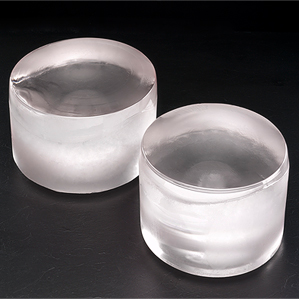
Manufactured sapphire—a material that’s used as transparent armor on military vehicles—could become cheap enough to replace the glass display covers on mobile phones. That could mean smartphone screens that don’t crack when you drop them and can’t be scratched with keys, or even by a concrete sidewalk.
Sapphire, a crystalline form of aluminum oxide, probably won’t ever be as cheap as Gorilla Glass, the durable material from Corning that’s used to make screens on iPhones and other smartphones. A Gorilla Glass display costs less than $3, while a sapphire display would cost about $30. But that could fall below $20 in a couple of years thanks to increased competition and improving technology, says Eric Virey, an analyst for the market research firm Yole Développement. And since sapphire performs better than glass, that price could make it cheap enough to compete, he says.
Sapphire is harder than any other natural material except diamond; by some measures, it’s three times stronger than Gorilla Glass, and it is also about three times more scratch resistant. That’s why Apple uses it now to protect the camera on its iPhone 5. Virey says that all major mobile-phone makers are considering using sapphire to replace glass. “I’m convinced that some will start testing the water and release some high-end smartphones using sapphire in 2013,” he says.
An alternative to using pure sapphire is to laminate an ultrathin layer of sapphire with another, cheaper transparent material, maintaining much of the performance advantage of sapphire at a cost comparable to that of the glass typical in mobile-phone displays.
For this purpose, GT Advanced Technologies, based in Nashua, New Hampshire, is developing a method for making sapphire sheets thinner than a human hair—much thinner than the nearly millimeter-thick glass used now on mobile phones. (The technology, originally developed for making very thin solar cells, was acquired from Twin Creeks Technologies. See “Startup Aims to Cut the Cost of Solar Cells in Half.”)
GT is also cutting the cost of sapphire manufacturing by following the strategy that it used over the last several years to reduce the cost of making crystalline silicon for solar cells.
To make the sapphire, aluminum oxide is melted down in a specialized furnace and then allowed to slowly cool to form a large crystal. That crystal is then cut with a diamond-coated wire saw. GT designs its furnaces so that they can be cheaply upgraded to make ever larger crystals as the technology improves, allowing customers to increase production without buying new equipment.
GT is more optimistic about prices than Virey, estimating that sapphire displays might cost only three to four times as much as those made from Gorilla Glass. People at the company say prices will fall further as GT improves its furnaces, and as the manufacturers that buy those furnaces streamline their operations.
Several other companies with proprietary technologies are also lowering the cost of sapphire, including Rubicon Technologies in the United States, Monocrystal in Russia, and Sapphire Technology in South Korea. If costs can get low enough, these manufacturers may have a large market waiting for them. But they’ll have to continue to contend with the incumbent technologies—Gorilla Glass and similar materials offered by other manufacturers. This year Corning introduced a new version of the material that it says is about twice as resistant to scratches. It could be in products later this year.
Apple announced a major reshuffle of its leadership late last year. Out went Scot Forstall, the man in charge of iOS development, and design guru Jony Ive was given additional responsibility of giving overall direction to iOS, as part of his new role as leader of Human Interface (HI) across the company.
According to a report in The Wall Street Journal, Sir Jonathan Ive is ready to put his stamp on Apple's next generation mobile OS. The report cites "people close to the company" to claim that iOS 7 will feature a 'flat design', that is 'starker and simpler'.
Some suggested that in Apple's next mobile operating system, Ive is pushing a more "flat design" that is starker and simpler, according to developers who have spoken to Apple employees but didn't have further details. Overall, they expect any changes to be pretty conservative. For the past few years, Apple has unveiled versions of its mobile operating system in the summer.
The report also says that the iOS team is now getting access to prototype iPhone hardware much earlier in the development cycle, compared to the earlier practice when the hardware team would share the same solely with its own software team.
That dynamic is changing, according to the people close to the company. The stealth software developers still exist. But now, Apple's mobile software, or "human interface" team, which has been led by executive Greg Christie, is being briefed about industrial prototypes earlier, these people said. The person described the change as "a thawing."
As the report notes, this is exactly the kind of increased collaboration that Cook was hoping for when he put Ive in charge, though it mentions that the Mac and iOS engineering teams are likely to remain independent for now despite the shared functionality and codebase.
Apple is widely expected to showcase iOS 7 at its World Wide Developers Conference (WWDC), typically held in June every year.
The lockscreen vulnerability seems to be haunting many smartphone makers. Samsung seems to be the latest victim to this. According to a news report it has been discovered a new flaw in the lockscreen of Samsung Galaxy Note II.With the help of this weakness an intruder can successfully take full control of the Samsung Galaxy Note II. So even if the smartphone is protected by a pattern, password, PIN or even face detection, it will take a few steps to bypass them and take control of the device.
It is noteworthy, that this lockscreen flaw is not on stock Android from Google. Only Samsung Galaxy Note II devices running on Android 4.1.1 or 4.1.2 are susceptible. As a matter of fact, even Samsung Galaxy S III seems to be unaffected by this vulnerability.
The only relief for the Samsung Galaxy Note II users is that it is not really a child's play to gain access to the smartphone. One will have to follow certain steps to be able to bypass the lockscreen. If you are curious to check out how to make most of this flaw, watch the video below.
Samsung has shared that the company will be rolling out an update to fix this problem at the earliest.
This is not the first time that a security flaw involving the emergency dialler of Samsung Galaxy Note II has been spotted. In the last exploit, the homescreen of Samsung Galaxy Note II could be used to launch programs and directly dial contacts from your phone. The process is again done through the emergency contacts area of the lock screen, and can give access to portions of a locked Galaxy Note II.
Recently, there was another security flaw discovered in the Samsung Galaxy S III that allows anyone to bypass the lock screen of the phone by following a few simple steps.
Nokia's cheapest Windows Phone variant Lumia 520 is as good as it gets.
Nokia 510 was the cheapest Windows 7.5 smartphone and now Nokia is back with an upgrade in the form of Nokia 520-by far the cheapest ever Windows Phone 8 based smartphone.
With it, Nokia has tried to establish one and one thing only and that is, devices can be cheaper while giving critical hardware too. The Nokia 520 with its Rs 10,500 price tag is even cheaper as compared to the earlier 510 that lagged behind due to certain limitations.
Nokia Lumia 520 was unveiled in a press conference today where we got a chance to go hands on with this new and exciting Windows Phone 8 device.
Look and feel
Nokia Lumia 520 looks and feels like a solid device, although there is not much to compare it with in the market. Relative to other budget smartphones out there Nokia's effort with the Lumia 520 is absolutely impressive.
The device comes in exciting color options with matte finish to avoid smudges and fading. The same technology that is used for making older Lumia devices has been adopted for these phones too, and the whole case is built color, so even if the case wears out the color stays intact. The design of the device is based very much on the design of Lumia 620, but for some obvious inclusions for reducing price.
Overall, the Lumia 520 comes as a refreshing new effort from Nokia that is bound to bring smiles to the faces of those who would not like to spend big bucks but who still want to taste Nokia's quality.
Hardware
Lumia 520 comes with a 4 inch display that does some impressive work. The display has a native resolution of 480 x 800 pixel. The device has a higher pixel density of about 227 pixel per inch, which makes the visuals look crisp and there is hardly any pixilation visible.
The display reproduces bright and vibrant visuals that complement the live tiles of the user interface of Windows Phone 8. The display is protected by a scratch resistant layer but not Gorilla Glass.
The device features a 1 GHz dual core processor to power the Windows Phone 8 operating system, and it has 512 MB of RAM. It gets 8 GB of onboard memory along with the option to upgrade it to another 64 GB with the use of micro SD cards. Brilliant as the Nokia 510 was, it missed out on extra memory and this was one of the major reasons for people disliking the phone.
Camera and apps
The Lumia 520 has a 5 megapixel autofocus camera capable of recording 720p resolution videos at 30 frames per second. The ¼ inch sensor is actually a great inclusion as it does full justice to visuals despite being in a low-end device. But the front camera is missing in action, though no regrets there. Nokia's lenses or camera applications will be compatible with the Nokia Lumia 520 as well and would help users add some great effects and actions to their pictures.
Along with that Nokia Drive's updated version with traffic information has been included in the Lumia 550 as well and is definitely a great addition for explorers and even city drivers. With the camera and Nokia's City Lens application users can surely explore new places or can get more information on places they have been visiting.
Entertainment
Apart from featuring a more than capable audio and video player Nokia has included an online audio streaming application called Nokia Music Mix that offers users song streaming and a ton of personalization features.
Finally
The Nokia Lumia 520 will be coming to markets in the next few days and it will come with a free 1 GB 3G data bundle for a month through Reliance. While the device is good the storage, which was the key point in deciding the fate of Nokia 510, has also been worked upon.
The Nokia Lumia 520 has all the potential and is more than capable with Nokia's applications that offer great utility for the device. So stay tuned for a detailed review of the device in the following weeks.
Google Inc's Chrome and Android operating systems will remain separate products, although there could be more "commonality" between them, Executive Chairman Eric Schmidt said on Thursday.
Google last week announced that Android architect Andy Rubin was moving to a still-undefined role at the company, while Sundar Pichai, the executive overseeing its Chrome web browser and applications like Google Drive and Gmail, was taking over Rubin's responsibilities.
Schmidt also said any rumour that he may be leaving Google is "completely false." He was responding to a question on whether his plan to sell about 42 percent of his Google stake was a signal that he was leaving the world's No.1 search engine.
"Google is my home," he said, adding that he had no plans to take on a job in government.

 Concept for a Samsung watch by Johan Loekito - Google is working on a separate device.